Hysteroscopy Procedure Explained—A Urogynecologist’s Guide to Diagnostic and Operative Hysteroscopy
If you’ve been advised to undergo a hysteroscopy procedure, it’s natural to feel anxious. The name sounds intimidating, but hysteroscopy is actually one of the least invasive procedures in modern gynaecology. There are no cuts, no external scars, and most patients return home the same day. More importantly, this small procedure can answer questions that other tests often cannot, helping diagnose the cause of infertility, abnormal bleeding, uterine polyps, fibroids, misplaced Copper-T devices, and more. This guide explains exactly what to expect, when hysteroscopy is recommended, and how it can help your doctor diagnose and treat several uterine conditions.
What is a hysteroscopy procedure?
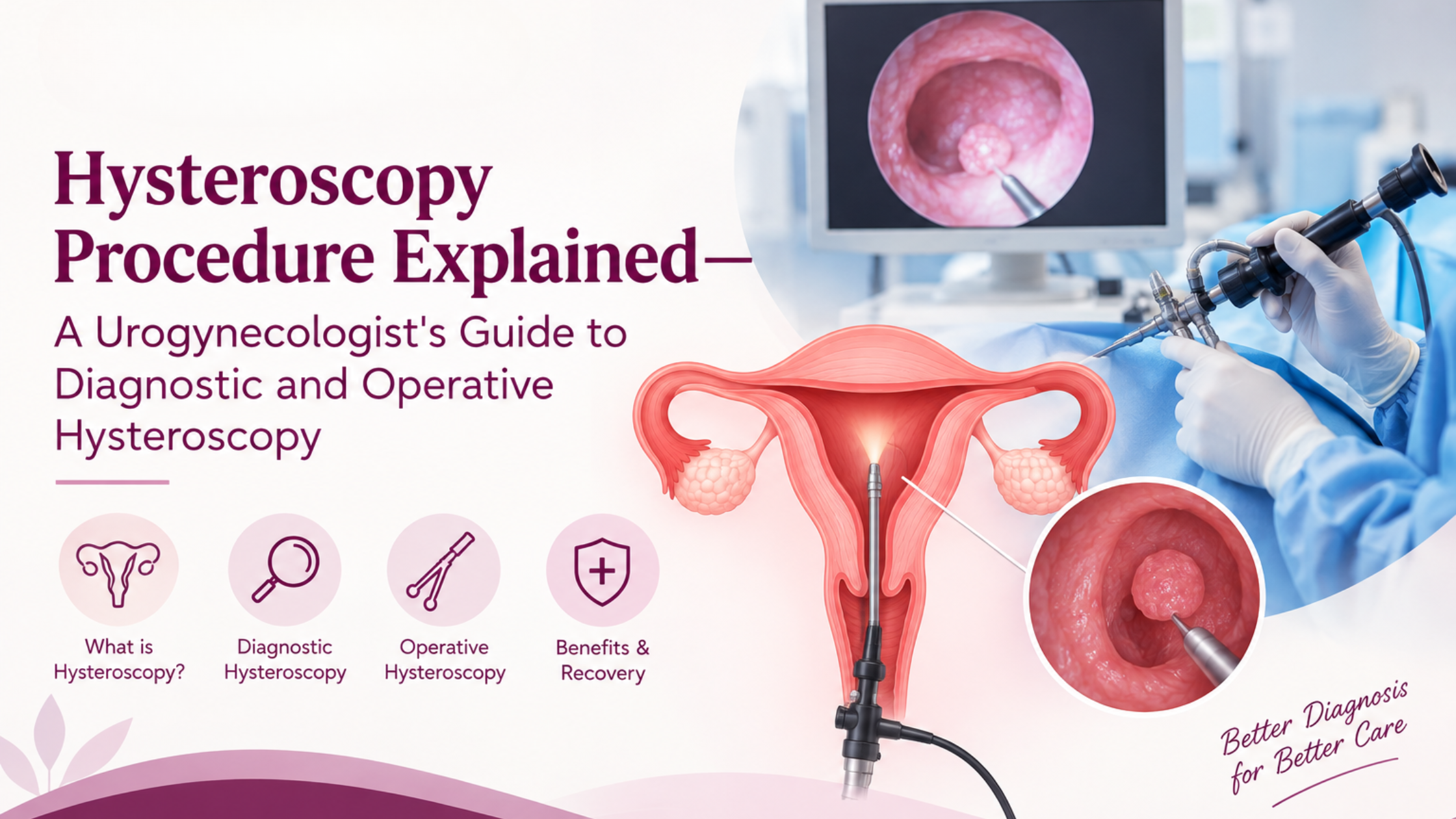
A hysteroscopy procedure is a minimally invasive technique that allows a doctor to look directly inside the uterus using a thin, lighted telescope called a hysteroscope. The hysteroscope is gently passed through the vagina and cervix into the uterus, so no abdominal incisions are required.
The camera attached to the hysteroscope provides a clear view of the uterine cavity, helping identify conditions that may not always be visible on ultrasound alone. In many cases, treatment can also be performed during the same procedure, avoiding the need for multiple surgeries.
For additional patient information, the American College of Obstetricians and Gynecologists (ACOG) provides an easy-to-understand guide on hysteroscopy.
Hysteroscopy may be recommended to investigate abnormal uterine bleeding, infertility, recurrent miscarriage, uterine polyps, fibroids, adhesions, congenital uterine abnormalities, or a misplaced Copper-T.
Diagnostic Hysteroscopy vs. Operative Hysteroscopy—Key Differences
Although both procedures use a hysteroscope, their purpose is different.
Diagnostic Hysteroscopy
A diagnostic hysteroscopy is performed to examine the inside of the uterus and identify the cause of symptoms or abnormal test results. It helps diagnose conditions such as—
- Uterine polyps
- Submucosal fibroids
- Scar tissue (Asherman’s syndrome)
- Congenital uterine abnormalities
- Retained pregnancy tissue
- Causes of abnormal uterine bleeding
The procedure itself does not usually involve treatment but provides valuable information for planning further care.
Operative Hysteroscopy
An operative hysteroscopy combines diagnosis and treatment in the same sitting. Through specialized instruments passed alongside the hysteroscope, the surgeon can treat many uterine conditions without making external cuts.
Common procedures include
- Removal of uterine polyps
- Removal of selected fibroids
- Cutting uterine adhesions
- Removal of a misplaced or embedded Copper-T
- Correction of selected uterine abnormalities
- Endometrial biopsy when indicated
Because diagnosis and treatment can often be completed together, many women avoid the need for a second procedure.
When is hysteroscopy recommended?
Your doctor may recommend a hysteroscopy procedure when symptoms suggest a problem inside the uterus or when imaging tests require further evaluation.
Common reasons include
- Abnormal or heavy menstrual bleeding
- Bleeding after menopause
- Infertility evaluation
- Recurrent miscarriage
- Suspected uterine polyps or fibroids
- Retained products of conception
- Missing/embedded Copper-T
- Abnormal ultrasound findings
- Congenital uterine abnormalities
Unlike ultrasound, hysteroscopy allows the doctor to directly visualize the uterine cavity, making it one of the most accurate methods for diagnosing many intrauterine conditions.
In selected cases, diagnostic hystero-laparoscopy may also be recommended to evaluate both the uterus and the pelvic organs during the same assessment.
Hysteroscopy for Infertility — What It Reveals
For women undergoing infertility evaluation, hysteroscopy for infertility can identify abnormalities inside the uterus that may affect implantation or pregnancy.
It may help detect-
- Endometrial polyps
- Submucosal fibroids
- Uterine adhesions
- Uterine septum
- Chronic endometrial changes
- Retained tissue following previous pregnancy
Because these conditions may interfere with embryo implantation or increase the risk of miscarriage, identifying and treating them can be an important part of fertility assessment in selected patients.
Learn more about female infertility evaluation by clicking this link.
Hysteroscopy for Abnormal Bleeding — Common Diagnoses
One of the most common reasons for hysteroscopy is abnormal uterine bleeding. While ultrasound often provides useful information, hysteroscopy allows direct examination of the uterine lining and helps determine the exact cause.
Conditions commonly identified are
- Endometrial polyps
- Submucosal fibroids
- Thickened endometrium
- Endometrial hyperplasia
- Scar tissue inside the uterus
- Retained pregnancy tissue
In many cases, these abnormalities can be treated immediately during an operative hysteroscopy, reducing the need for additional procedures.
How to Prepare for Hysteroscopy Surgery?
Preparation depends on whether you are having a diagnostic or operative hysteroscopy and whether anesthesia is required.
Your doctor may advise you to—
- Share your complete medical history and current medications.
- Inform your doctor if you are pregnant or think you may be pregnant.
- Complete any recommended blood tests or imaging.
- Fast for a few hours if anesthesia is planned.
- Arrange for someone to accompany you home after the procedure if sedation or general anesthesia is used.
Your healthcare team will explain each step beforehand and answer any questions so you know exactly what to expect before the procedure.
What Happens During the Procedure?
A hysteroscopy is usually performed as a day-care procedure, meaning most women return home the same day. Depending on the reason for the procedure, it may be done with local, regional, or general anesthesia.
During the procedure—
- A hysteroscope is gently inserted through the vagina and cervix into the uterus.
- Sterile fluid is introduced to expand the uterine cavity for a clear view.
- The uterine lining is carefully examined.
- If needed, specialized instruments are used to perform treatment during the same procedure.
Because there are no abdominal incisions, recovery is generally quicker than with traditional open surgery.
Hysteroscopy Treatment—What Can Be Done in One Sitting
One of the biggest advantages of operative hysteroscopy is that diagnosis and treatment can often be completed during the same procedure.
Common treatments include-
- Removal of uterine polyps
- Removal of selected submucosal fibroids
- Treatment of uterine adhesions (Asherman’s syndrome)
- Removal of an embedded or misplaced Copper-T
- Correction of selected uterine abnormalities
- Targeted endometrial biopsy when required
Treating these conditions hysteroscopically avoids external cuts and may reduce recovery time compared with more invasive procedures.
Learn more about hysteroscopic removal of Copper-T & how it is performed.
Recovery After Hysteroscopy Surgery
Recovery is usually quick, although it varies depending on whether you had a diagnostic or operative hysteroscopy.
Patients can also refer to the Royal College of Obstetricians and Gynaecologists (RCOG) for additional information about outpatient hysteroscopy and recovery.
Most women can expect—
First 24 Hours
- Mild cramping similar to menstrual pain
- Light vaginal spotting
- Return home on the same day in most cases
First Few Days
- Gradual improvement in discomfort
- Return to light daily activities as advised
- Avoid intercourse or tampon use until your doctor recommends
Follow-up
Your doctor will discuss the findings, review biopsy results if taken, and advise whether any additional treatment is needed.
Seek medical attention if you develop severe pain, heavy bleeding, fever, or foul-smelling discharge after the procedure.
Choosing a Hysteroscopy Specialist
A successful hysteroscopy depends not only on the equipment but also on the experience of the surgeon performing the procedure.
When choosing a specialist, look for someone who—
- Performs both diagnostic and operative hysteroscopy regularly
- Has experience treating infertility, abnormal bleeding, fibroids, and uterine polyps
- Is trained in advanced minimally invasive gynaecological surgery
- Explains treatment options clearly and individualizes care
- Offers comprehensive follow-up after the procedure
For complex uterine conditions, consulting an experienced hysteroscopy specialist can help ensure accurate diagnosis and appropriate treatment.
Final Words
A hysteroscopy procedure is one of the most valuable minimally invasive tools in modern gynaecology. Whether performed to investigate abnormal bleeding, infertility, recurrent miscarriage, or a suspected uterine abnormality, it provides a clear view of the uterine cavity while often allowing treatment during the same sitting.
If your doctor has recommended hysteroscopy, understanding the procedure can help reduce anxiety and prepare you for what to expect. With experienced specialist care, hysteroscopy is a safe, effective, and minimally invasive option for diagnosing and treating many uterine conditions.
If you have persistent symptoms or have been advised to undergo hysteroscopy, consult an experienced urogynecologist or minimally invasive gynaecological surgeon to discuss the most appropriate approach for your individual condition.
If you have been recommended a hysteroscopy, or if you have unexplained infertility, abnormal bleeding, or persistent pelvic symptoms that have not been diagnosed. Dr. Indira Sarin offers hysteroscopy assessment as a day-care procedure at Urja Medicenter. Book a consultation on WhatsApp +91 77259 24746.
FAQs
Q1. Is hysteroscopy a painful procedure?
A1. Hysteroscopy is not usually painful because it is performed under anesthesia—either short general anesthesia or mild sedation. Most patients report mild cramping or discomfort during recovery, similar to period pain, which settles within 24 hours.
Q2. Do I need to be admitted for hysteroscopy surgery?
A2. Hysteroscopy is a day-care procedure. You arrive in the morning, the procedure takes 20 to 60 minutes depending on what is being done, and you are usually discharged within 3 to 4 hours. You can go home the same day.
Q3. How soon can I go back to work after hysteroscopy?
A3. Most patients return to work in 1 to 2 days for diagnostic hysteroscopy and within 3 to 5 days for operative hysteroscopy. Avoid heavy lifting and intense exercise for one week. Sexual activity can usually resume after 7 to 10 days.
Q4. When during my cycle should hysteroscopy be done?
A4. Hysteroscopy is best performed in the first half of the menstrual cycle—between day 6 and day 12, after your period ends but before ovulation. The uterine lining is thinnest during this window, giving the clearest view. Your specialist will schedule accordingly.
Q5. Can hysteroscopy improve my chances of pregnancy?
A5. Yes, in many cases. If a hysteroscopy identifies and treats a fixable cause of infertility—a polyp, fibroid, adhesion, or uterine septum—pregnancy rates often improve significantly afterward. It is also frequently done before IVF to give the embryo the best possible environment.
Q6. Are there risks or complications from hysteroscopy?
A6. Serious complications are rare. Minor risks include cramping, spotting, mild infection, and, very rarely, uterine perforation. Choosing an experienced hysteroscopy specialist significantly reduces even these small risks.
Q7. Will I have scars after hysteroscopy?
A7. No. Hysteroscopy uses a natural passage—through the cervix into the uterus—so there are no cuts and no external scars. This is one of the key advantages of the procedure.