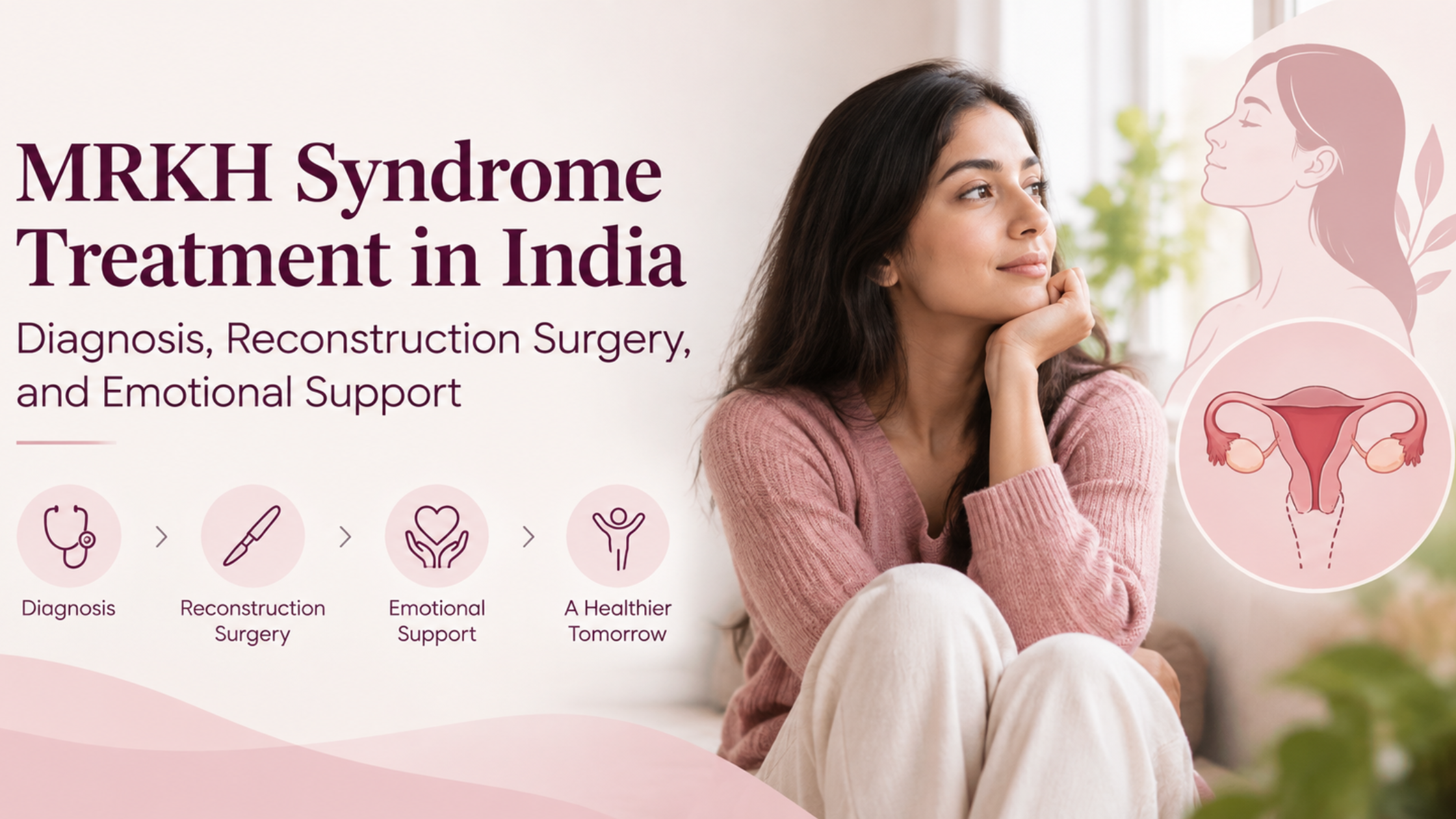
MRKH Syndrome Treatment in India—Diagnosis, Reconstruction Surgery, and Emotional Support
If you or your daughter has recently been told about MRKH syndrome, you are probably feeling overwhelmed, scared, and full of questions. That is completely understandable. Although hearing this diagnosis can be shocking, MRKH syndrome treatment has advanced significantly, and women with MRKH can lead healthy, fulfilling lives with modern medical care and emotional support. This guide explains what MRKH is, how it is diagnosed, available treatment options, fertility possibilities, and where to find compassionate specialist care in India.
What is MRKH Syndrome?
Mayer Rokitansky Kuster Hauser syndrome (MRKH syndrome) is a congenital condition in which the uterus and the upper part of the vagina do not fully develop before birth. Although the reproductive anatomy develops differently, the ovaries usually function normally, hormone levels are typical, and girls experience normal breast development and other signs of puberty.
MRKH is not life-threatening, nor does it affect intelligence, femininity, or gender identity. Additional information about the condition is also available from the National Organization for Rare Disorders (NORD). With appropriate treatment and support, women with MRKH can enjoy healthy relationships, active lives, and several options for family building.
Understanding Congenital Absence of Uterus
One of the defining features of MRKH is the congenital absence of a uterus or an underdeveloped uterus. The upper portion of the vagina may also be shorter than usual, while the ovaries, external genitalia, and chromosomes (typically 46, XX) are generally normal.
Because the ovaries continue to produce hormones and eggs, girls with MRKH usually experience normal puberty. However, they do not have menstrual periods because the uterus is absent or not fully developed.
It is important to understand that MRKH is a congenital condition, meaning it develops before birth. Nothing a mother did, or did not do, during pregnancy causes MRKH.
A Note for Parents
Learning that your daughter has MRKH can be emotionally overwhelming. Please remember that this condition is not your fault, and it does not define your daughter’s future. With the right medical care and family support, she can lead a full and meaningful life.
MRKH Symptoms and When It Is Usually Diagnosed
Most girls with MRKH are diagnosed during their mid-to-late teenage years when they do not begin menstruating despite otherwise normal puberty. This is known as primary amenorrhea.
Common signs include
- No menstrual periods by the expected age
- Normal breast development and body hair
- Difficulty using tampons in some cases
- Shortened vaginal length in some women
Because puberty appears completely normal, MRKH often comes as a surprise to both the young woman and her family.
If periods have not started by the age recommended for medical evaluation, it is important to consult a gynaecologist rather than assuming they will begin later.
Girls experiencing delayed puberty or primary amenorrhea may benefit from a consultation focused on addressing adolescent gynecology issues to ensure an accurate diagnosis and appropriate care.
How is MRKH Syndrome Diagnosed?
Diagnosis begins with a detailed discussion about medical history and menstrual development, followed by a gentle physical examination when appropriate.
Your doctor may recommend—
- Pelvic ultrasound
- MRI scan for detailed pelvic anatomy
- Chromosomal analysis
- Kidney evaluation, as some women with MRKH may have associated urinary tract differences
These investigations help confirm the diagnosis and determine the most appropriate treatment plan. They also help rule out other conditions that may cause delayed menstruation.
Early consultation with an experienced MRKH specialist allows families to receive accurate information, emotional support, and guidance about future treatment options.
Vaginal Agenesis Treatment Options: Non-Surgical vs. Surgical
The best vaginal agenesis treatment depends on each woman’s anatomy, goals, and readiness for treatment. There is no need to rush, and decisions should always be made together with an experienced specialist.
Non-Surgical Treatment
For many women, progressive vaginal dilator therapy is the recommended first-line treatment. Using specially designed dilators under professional guidance can gradually create a functional vaginal canal without surgery. When performed consistently, this approach has a high success rate.
Surgical Treatment
If dilator therapy is unsuccessful or not preferred, MRKH surgery may be considered. Modern reconstructive techniques aim to create a functional vagina while preserving normal surrounding anatomy.
Learn more about vaginoplasty and vaginal reconstruction.
MRKH Surgery—Reconstruction Techniques Explained
Several approaches are available for MRKH reconstruction surgery, and the choice depends on the individual’s anatomy, lifestyle, and preferences.
Common techniques include-
- McIndoe vaginoplasty
- Davydov procedure
- Vecchietti procedure
- Advanced laparoscopic reconstruction
Minimally invasive laparoscopic techniques may offer advantages such as smaller incisions, less postoperative discomfort, and faster recovery in appropriately selected patients.
The decision to proceed with surgery should always be made after detailed counselling about the expected outcomes, long-term care, and the importance of postoperative dilator therapy.
Want to learn more about cosmetic and reconstructive gynecology? Follow the link.
MRKH Reconstruction Surgery Recovery
Recovery varies depending on the type of reconstruction performed and each woman’s overall health. Your surgeon will provide personalized instructions based on your procedure.
In general—
- First few days—Mild discomfort and swelling are common and usually improve with prescribed medication.
- First few weeks—Most women gradually return to light daily activities as advised by their doctor.
- Long-term—Regular follow-up is important, and many patients are advised to continue vaginal dilator therapy to maintain the reconstructed vaginal canal and achieve the best long-term outcome.
Recovery is a gradual process, and patience, consistent follow-up, and open communication with your healthcare team are essential.
Fertility Options for Women with MRKH
One of the first questions many families ask after an MRKH diagnosis is, “Will she ever be able to have children?”
Although women with MRKH do not have a functional uterus and therefore cannot carry a pregnancy themselves, their ovaries usually function normally and produce healthy eggs. This means biological motherhood may still be possible through assisted reproductive options.
Depending on individual circumstances and local regulations, family-building options may include-
- IVF using the woman’s own eggs with gestational surrogacy, where legally permitted
- Adoption
- Future reproductive technologies as research continues to advance
Every woman’s journey is different. Fertility counselling can help patients and families understand the available options and make informed decisions based on their personal goals.
Learn more about female infertility evaluation and treatment.
Emotional and Psychological Support for MRKH Treatment in India
For many young women, the emotional impact of MRKH can be just as significant as the physical diagnosis. Feelings of sadness, confusion, anger, or anxiety are common, especially during adolescence when identity, relationships, and plans are taking shape.
Support from family, friends, counselors, and experienced healthcare professionals can make a meaningful difference. Speaking openly about concerns and connecting with others who have experienced MRKH often helps reduce feelings of isolation. Support organizations such as the Beautiful You MRKH Foundation also provide educational resources, advocacy, and community support for women and families living with MRKH.
It is equally important for parents to remember that their daughter is much more than this diagnosis. With understanding, encouragement, and appropriate medical care, she can pursue education, relationships, a career, and a fulfilling future with confidence.
Finding an MRKH Specialist in India
Because MRKH is a rare condition, evaluation and treatment should ideally be provided by a specialist experienced in congenital reproductive tract anomalies and pelvic reconstructive surgery.
When choosing an MRKH specialist, look for someone who
- Has experience treating MRKH and vaginal agenesis
- Offers both non-surgical & surgical treatment options
- Provides personalised counselling for patients and families
- Works with fertility specialists, psychologists, and other experts when needed
- Offers long-term follow-up & ongoing support
A compassionate, multidisciplinary approach ensures that treatment addresses both physical health and emotional well-being. Patients and families may also find helpful educational materials and peer support through the MRKH Organisation.
Final Words
Being diagnosed with MRKH syndrome can feel overwhelming, but it does not define your future. Advances in MRKH syndrome treatment, reconstructive surgery, fertility care, and psychological support have helped many women build confident, independent, and fulfilling lives.
If you or your daughter has recently been diagnosed with MRKH, seeking guidance from an experienced specialist is an important first step. Every treatment plan should be personalised, with decisions made at a pace that feels right for the individual and her family.
As Dr. Indira Sarin believes, the goal of treatment is not only to provide expert medical care but also to help every young woman move forward with confidence, dignity, and hope.
Being newly diagnosed with MRKH can feel isolating, but you are not alone, and you have time. Dr. Indira Sarin offers unhurried, private consultations for MRKH patients and their families, with a focus on emotional support alongside clinical care. WhatsApp +91 77259 24746 or book a private consultation at Urja Medicenter, Jaipur.
FAQs
Q1. Is MRKH syndrome life-threatening?
A1. No. MRKH does not affect life expectancy or general health. It affects reproductive anatomy, specifically the uterus and upper vagina, but ovarian function, hormones, and overall health are usually normal. With appropriate treatment, women with MRKH lead full, healthy lives.
Q2. Will my daughter be able to have children?
A2. Biological motherhood is possible for most women with MRKH through gestational surrogacy, since the ovaries are usually fully functional and produce eggs normally. Uterine transplantation is an emerging option, though it is still experimental in India. Adoption is also a meaningful path many families choose.
Q3. What is the best treatment for MRKH dilators or surgery?
A3. Dilator therapy is the recommended first-line treatment globally because it is non-surgical, safe, and successful in 90 to 95 percent of motivated patients. Surgery is offered when dilator therapy is unsuccessful or not preferred. A specialist will help you decide based on your individual case.
Q3. When is the right age to start MRKH treatment?
A3. Treatment is usually started in the late teens or early twenties, when the young woman is emotionally ready and motivated to participate in her care. There is no rush. Some women choose to delay treatment until they are in a stable relationship or planning to become sexually active.
Q4. Will surgery make everything feel and function normally?
A4. Modern reconstruction techniques create a neovagina that allows for normal sexual function and intimacy in the vast majority of patients. Sensation, lubrication, and orgasm are usually preserved because the external genitalia and clitoris are unaffected in MRKH. Realistic expectations and follow-up care matter for the best outcome.
Q5. How is MRKH different from being transgender?
A5. MRKH is a congenital difference in reproductive anatomy, a woman with MRKH is a woman, biologically and genetically (typically 46, XX). It is not related to gender identity. This distinction is important because MRKH patients are cis women born with a variation in reproductive development.
Q6. Are there support groups for women with MRKH in India?
A6. Yes. Online communities such as the Beautiful You MRKH Foundation and the MRKH Organisation provide peer support, information, and connection with other women. Some Indian urban centers also have private support networks. Your specialist can connect you with resources appropriate to your situation.