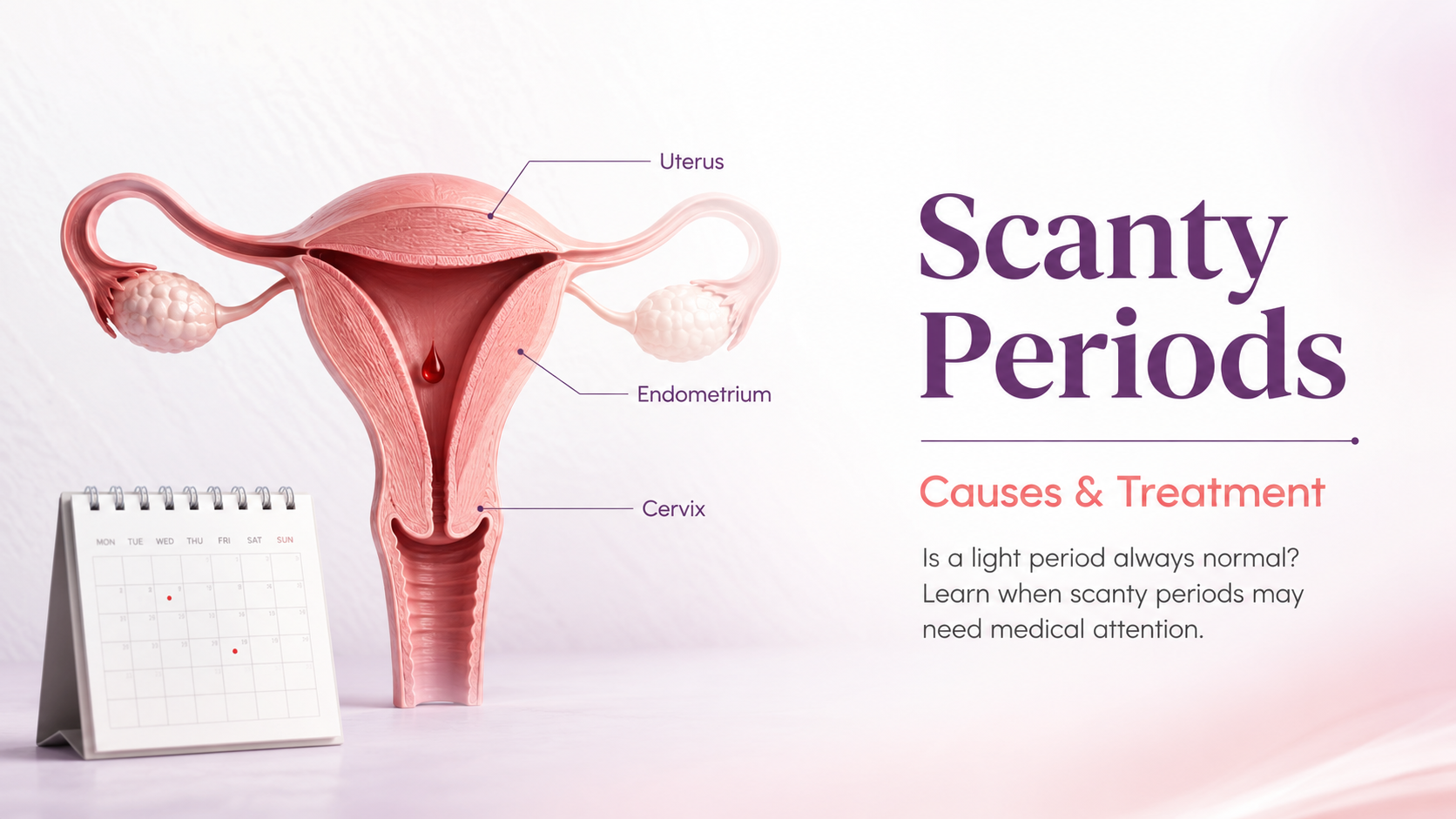
Many women simply shrug it off and walk away with the comment, ‘My periods are just light. However, in my practice, I’ve noted that the seemingly small change can be a sign of a deeper issue. If something is not quite right with the periods, this is a condition that is usually overlooked but is worthy of attention: scanty periods, or hypomenorrhea. Let’s listen to what your body is saying. Early evaluation is key, and treatment is usually straightforward once the cause is identified.
What Does a Scanty Period Mean?
A scanty period is characterized by significantly lighter menstrual flow and a shorter duration than a normal period.
Medical definition of hypomenorrhea
Hypomenorrhea treatment, in medical terms, is defined as menstruation that lasts less than 2 days and blood loss is less than 20 ml per cycle. Many women will feel that they need very few pads and/or light spotting rather than a large flow.
What counts as “normal” menstrual flow?
The important part of this now is “normal,” which is not the same for women. If a woman has naturally lighter periods, then this may not be a problem. However, if your periods have gotten lighter over time, we’re going to dig deeper.
How to tell if your period is actually scanty?
Bleeding that lasts only a few days at the most, which may require only one or two sanitary pads, and involves little or no spotting is probably the type of bleeding being referred to. Many women say they have only needed one or two sanitary pads during their menstruation or have not needed to use one at all, implying that full protection may not be needed the entire time. It is very important to keep tabs on your cycle, as changes in your bleeding pattern may indicate that you need to classify your menstrual cycle as hypomenorrhea.
Common Causes of Scanty Periods
There are many common scanty menstruation causes. I think that not having full periods doesn’t happen by chance. In most cases, there is a cause, which is normally hormonal and sometimes structural. The very common cause, which is frequently overlooked, is that of thyroid imbalance. Thyroid always tested when periods change, always.
Then there’s PCOS that I see all the time. It does not necessarily lead to missing periods; it can sometimes be regular but scanty periods.
The following is a summary of the common causes:
Cause | Key Identifying Sign |
Hormonal Imbalance | Irregular periods, mood swings, acne |
Thyroid Disorders | Fatigue, hair thinning |
PCOS | Acne, weight gain, delayed ovulation |
Asherman’s Syndrome / Post-Surgery | Very light periods after uterine procedures |
Perimenopause | Age above 40, cycle changes |
Low Body Weight | Excess dieting or heavy exercise |
Stress | Sleep issues, anxiety, lifestyle changes |
Birth Control (Pills/IUD) | Lighter periods after starting contraception |
Recent uterine surgery or D&C
The enzymes or hormones are a key factor in developing the lining of the uterus, particularly oestrogen and progesterone. If this lining is not formed well, then bleeding will, of course, be lighter.
Regular but Scanty Periods — What This Means
Scanty periods are also referred to as rare periods. It’s here that many women become confused.
“Every month I get my period, it must be ok.”
Not necessarily.
When your cycle is on time, but the flow is very light?
Not all regular periods are healthy periods. If the flow is always very light, this can be a sign of a lack of uterine development. However, if their periods are usually very light, it may be a symptom of insufficient uterine lining development. It may be associated with a hormonal imbalance, stress, or some diseases that would affect menstrual health overall.
Why regularity doesn’t always mean all is well.
Regularity does not always imply that everything is perfect. Having a regular menstrual cycle only means that the timing is right; however, it does not mean that the woman has good quality cotton.
How to track your cycle accurately for diagnosis?
My patients are always encouraged to record three things:
- Cycle length
- Flow intensity
- Duration
Just a quick text to your doctor on your phone can help give your doctor a better understanding of patterns.
Scanty Periods and Fertility — Should You Be Worried?
If you have scanty periods and you are not pregnant, is there any reason to worry about your fertility?
It’s one of the most frequent questions I get in my office. Not all cases are alarming, but if your periods are consistently scanty, you should take this into account when trying to conceive.
When scanty periods affect the uterine lining
The amount of menstrual flow is closely connected to how thick the lining of the uterus (endometrium) is. When there are scanty periods, it is often associated with the fact that the uterine lining is not thick enough and cannot support pregnancy.
Link between hypomenorrhea and implantation difficulty
A thin endometrium can hinder the process of implantation because the embryo needs a good endometrial surface for attachment and growing. Hormonal imbalance (lack of estrogen) is usually to blame for this.
Scanty periods after miscarriage or D&C — Asherman’s risk
If you observe scanty periods after a miscarriage or D&C procedures, you might develop intrauterine adhesions, which is referred to as Asherman’s syndrome. It plays a role in diminishing the menstrual flow and influencing fertility issues.
Can you get pregnant with scanty periods?
It is possible to become pregnant with light periods. If you’ve been trying to conceive and have found your cycles lighter, though, you should check out early, instead of waiting.
Diagnosis — What Will a Doctor Check?
If you bring an issue to us related to low periods, we don’t simply make up answers. A structured evaluation is useful to ascertain the specific cause.
Hormone blood test (FSH, LH, oestrogen, progesterone, TSH)
A hormone blood test usually forms the first step in evaluating scanty menstruation as it assesses whether reproductive hormones are at normal levels and functioning normally. Checking levels of FSH and LH reveals ovarian activity, while measuring oestrogen and progesterone displays the state of the endometrium. TSH is equally important here as the role of thyroid disorders should not be underestimated in terms of their influence on menstrual flow.
Pelvic ultrasound
A pelvic ultrasound is useful to see the uterus and ovaries. It provides information concerning the endometrial thickness and enables the diagnosis of PCOS or abnormality in the structure of the uterus that results in scanty flow due to the thin uterine lining.
Hysteroscopy for suspected Asherman’s syndrome
In case intrauterine adhesions are suspected, hysteroscopy is used to visualize the intrauterine space directly. This method is both diagnostic and therapeutic as it allows identification and treatment of scar tissue.
When further investigation is needed
If scanty menstruation persists after performing the above tests, additional tests may be required to rule out serious hormonal or structural problems.
Treatment Options for Scanty Periods
Scanty periods can be treated with a variety of methods. There are several treatment options for scanty periods. The positive aspect is that most causes of scanty periods can be treated. Treatment is always based on the cause of the problem.
Hormonal therapy to restore cycle balance
If it is due to hormone imbalance, hormonal therapy can be given to control the cycle and to stimulate endometrial development.
Thyroid correction and its effect on periods
When thyroid levels are abnormal, correcting this often results in normal menstruation within a remarkably short time.
PCOS management — lifestyle, medication, and beyond
A diet that is healthy combined with lifestyle changes, weight control, and medication can make a world of difference in the world of menstruation for PCOS.
Hysteroscopic treatment for Asherman’s syndrome
In instances of Asherman’s syndrome, hysteroscopy may be used to break up scar tissue and open the uterus.
Nutritional support and weight restoration
Enhancing nutrition and reaching a healthy weight is crucial in improving hormone balance and menstrual health.
When to stop the contraceptive and reassess
If contraceptives are causing short periods, stopping them under doctor’s advice can help in reevaluating the natural cycle.
When Should You See a Doctor About Scanty Periods?
Correct diagnosis is the key. So many times, people treat blindly, without understanding what is causing the issue, and are frustrated. If your periods are lighter than usual, when should you go to the doctor? To my patients, I always say—”Pay attention to your body.
Sudden change from a previously normal flow
If the menstruation was normal before, but suddenly it is lighter or shorter, that may mean a hormonal imbalance or some other disorder.
Scanty periods with other symptoms (fatigue, hair loss, hot flushes)
Scarce menstruation accompanied by other symptoms: Light cycles can be accompanied by some other symptoms like lack of energy, hair loss, or hot flashes that can suggest some thyroid problems or hormonal imbalance, or even perimenopause.
Trying to conceive with scanty periods
If you are planning pregnancy, but have regular light cycles, it would be recommended to evaluate the condition of your uterus lining and check whether you are ovulating or not.
Periods that have been scanty for 3+ cycles
If the menstrual period has been regular for three cycles and has become scanty since then, it should not be ignored, as it may signify some kind of hormonal or structural disorder. Early evaluation helps avoid complications later in life and provides us with greater treatment options.
FAQs
Q1. Can stress alone cause scanty periods?
Yes, chronic stress does affect the balance of hormones and also causes a decrease in menstrual flow.
Q2. Are scanty periods a sign of early menopause?
They can be, particularly when they are along with other symptoms such as hot flushes or irregular periods.
Q3. Is it normal to have scanty periods after pregnancy?
It may occur for a short time; however, if the changes are ongoing, they should be considered.
Q4. Can iron deficiency cause light periods?
While the most common cause of iron deficiency is excessive menstrual bleeding, health imbalances in general can have an effect on cycles.
Q5. How are scanty periods treated in India?
Treatment varies depending on the cause and can involve hormonal medication, correction of the thyroid, lifestyle changes, or minimally invasive treatments.
Final Words
Scanty periods are not something you can turn a blind eye to, particularly if they are abnormal. Usually the cause is something that is controllable, and when we know what the cause is, treatment is possible.
Your menstrual cycles are a barometer of your health; which as I have always told my patients. If it does change, it’s important to know what causes it. “If your periods have become lighter or shorter, consult Dr. Indira Sarin for a thorough hormonal and uterine evaluation.”